Comics and Cartooning: UK Election 2010

A re-blog from the archives of my regular column for (now extinct) Alltern8; Comicking.

With the UK general election happening this week, democracy gets opportunity to curtail the taint destructive politicians have left on the world stage. I thought it might be interesting to deliver a round-up of what some British cartoonists have been saying on the matter.

Labour or the Conservatives (or ‘Unionists’, as they used to be known, and sometimes are in Northern Ireland) have held power for 65 years. So, care of Sean Duffield, a four page look at the Labour leader, David Cameron,

Cameron Taxi Driver

Ah yes, Cameron’s friendship with Rupert Murdoch, Google-fearer and owner of the British registered Newscorp (BSkyB, The Sun, The Times), which avoids paying tax in Britain.

Might we be seeing this sort of thing in a Murdoch-Cameron Britain?

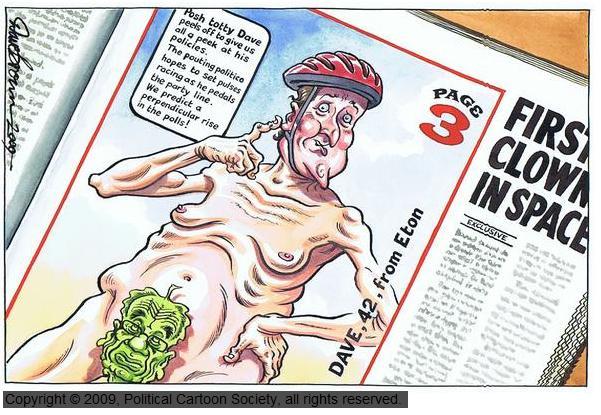
Dave Brown The Independent 2009

Um, sorry? Dave Brown, 2009

Marc Roberts of Throbgoblins,
“I’ve been playing around on PhotoShop (other image manipulation programmes are available) and have come up with the following. It’s mostly a tad sinister – UK politics and the pending ecological debacle”

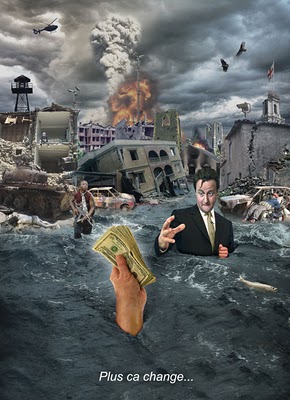
Here’s his ApoCameron-lypse,

ApocalyptoCAMERON(web)

Crazy internet-fearing Murdoch, drawing threats on the BBC, a public service broadcaster funded by the public since 1933 with it’s aim to present fair impartial reporting.
Here’s a cartoon on favourite LibDem Clegg’s victory by Rich Johnston from the 26th April as originally posted to Guido Fawkes.

RichandMark 26 April

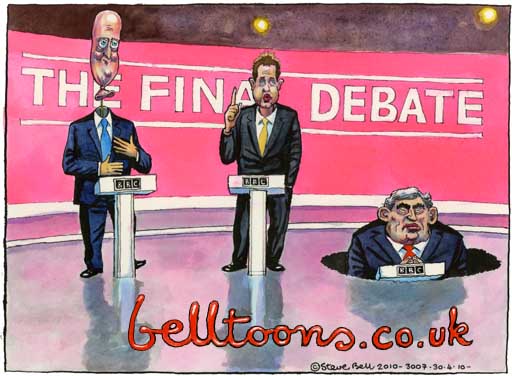
And of course, the always admirable Steve Bell in his work for The Guardian,

3007-30-4-10_FINALDEBATE

So, really a televised leadership election debate should have taken place at the BBC rather than being relegated to third place after the commercially funded ITV and Murdoch’s private BSkyB.

6559-26-4-10_BEARDCHANGE

6560-27-4-10_BEARDCHANGE

Above: Two more from Steve Bell and The Guardian.

Now the UK have a chance to lock Murdoch out of UK politics and cut the propaganda that has seen the nation’s Green Parties, the welsh Plaid Cymru, the Scottish National Party and others locked out of these debates.

Oh, and this guy too.

fascist guy_72dpi

Source: Duffield

2849-28-5-09_GRIFFINPARTY

Source: Bell

The image above by Holocaust-denying racist Nick Griffin, parasite to re-opened multi-party politic talk. It’s another by Sean Duffield: Go and donate a few pounds towards War – The Human Cost, a brilliant BRILLIANT anthology he’s hoping to get out.

The BBC brought us the iconic kids show Bagpuss, and here’s Sean take on Gordon Brown.

sagpuss_page1_with_text_78 sagpuss_page2_mice_and_text_78dpi

Marc Roberts goes for high pitch animals too,

BROWNgorrilla(MINI)(web)

This will be the first UK election since Web 2.0 has fully worked it’s way into British culture. Hopefully we’ll not get any Votergate-type scandals and see elected tolerable agenda for the job.

Murdoch isn’t the only unelected dictator we need to get rid of, after all.

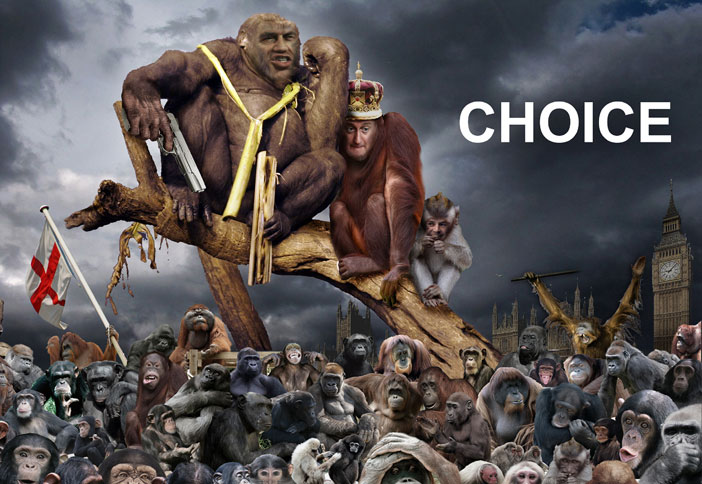
demonicolour468

Source: Mark and Rich, Guido Fawkes

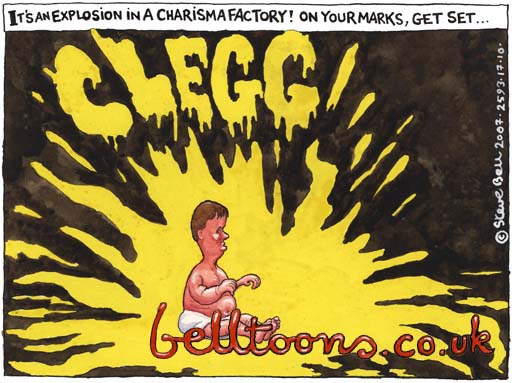
And what of this man?

2593-17-10-07_CLEGG

By Steve Bell

He may very well be the UK’s new Prime Minister.

Modern politics is driven by who you can’t vote for, rather than who you’d like to. Still, being cooped up in Westminster talking only to other politicians is an uneconomical reality to face.

2963-2-2-10_GUILLOTINES

The above cartoons are by Steve Bell. There are some more of them here.

Dave Brown, then Peter Schrank (The Independent) as to how they’re not really of the same thinking state as many of us,

(IMAGES FROM ORIGINAL ARTICLE MISSING)

Some things are just too prescient. Morland Moreton from The Times way back in 2006..

(ORIGINAL IMAGE MISSING)

Please vote on Thursday. Sure they’re all crap, but not voting helps keep them in power. Remember, ‘Hung parliament’ is code for greater democracy.

If you’re interested in similar, less conservative attitudes to British political cartooning try the works of BRICK (aka John Stuart Clark), Kate Evans,Polyp and Kate Charlesworth.

Scroobius Pip – Poetry in (e)motion

A re-blog from the archives of my regular column for Alltern8; Comicking.

http://titanbooks.com/products/uk/10750-poetry_in_emotion_the_illustrated_words_of_scroobius_pip/ scroobius - back cover intro

Artists across the Atlantic picked up their instruments to accompany Hip-Hop poet Scroobius Pip and lay new dimensions to his range of pieces. The illustrations largely draw from the language of comic strip, although only CJ McCracken’s work employs speech bubbles, and they’re quite suited. In his introduction, Scroobius recalls being shown a comic book on philosophy and finds the subject matter accessible because of the form it was presented in. As fair a testament as any to the excellent alchemy at work within this book. Each of the artists bring very different styles to very different works.

scroobius - intro

The scribbly scrawly of beserk and abandon of Cowfree relating Scroobius’ head time in ‘Rat Race’.

Ben Williams, On Thou Shalt Not Kill, delivers meticulous AND free-form zine culture sigil art.

Damian Claughton’s Phonogram-esque designs, impressing style and warmth and class, at home with this piece of book: professional and managing simplicity.

Joe Cunningham’s contribution to “When I Grow Up” which approaches like your favourite dog: full of love, bringing belonging and an ounce of silliness. Cunningham is part-Herge.

Anthony Gregori and Michael Spicer on “1,000 Words”, underwater mysticism, with a fairytale quality which would have been at home in the DFC.

CJ McCracken’s shaped orange and greys, sliding and angular, going for that slacker webcomic feel.

Mister Paterson’s living tattoo man, frozen with animated arms, alike a comix real treatment of a DC character in “Shamed”, the empathic and undoubtedly stark relation to homelessness.

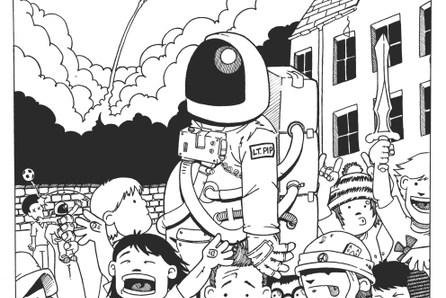
scroobius - artists

sb_cover.jpg.size-230

Often from darkest places, Scroobius is and Co. are on missions to retrieve and return with insight and inspiration. This is most evident in “The Magician’s Assistant”, a love poem and hell rage on the subject of self-harm. It’s deeply compassionate in realism to the point. The most effective work I’ve seen on the matter. It’s an engaging survival call which illustrator translates perfectly the integrity of in sketchbook and scrapbook collage. Both artists come across as nothing less than genuinely important and brilliant.

From dark places also come delightfully frivolous works, which impart experiential wisdom. Matt Frodsham and Pip team up on a wonderful blend of these matters in “Waiting for the beat to kick in”. Poetry in the form of structured short story, Scroobius relates meetings with characters from some of his favourite old films. Elwood P Dowd (Harvey), Lloyd Dobler (Say Anything), Billy Brown (Buffalo ’66) and Walter Neff (Double Indemnity) are each encountered by the narrator on his journey through the city. Frodsham illustrates their attempts to offer advice in exemplary cine noir style. Like Pip, his senses have paid close attention to the screen and the record re-envoked here is a joy to see.

The theme of advice runs through the book, subject to scrutiny and so rarely annoys as preachy. Scroobius etc seduce, and employ the fine coffee table edition quality print to good effect. Titan Books have generously made this 104-page hardback accessible by putting it out for a tenner ($17.95 US/$21.50 CAN). The book’s (possibly uncredited) designers provide the collection a strong visual feel which give it an extra showiness.

The piece is lined with a great set of sleeve notes from Scroobius Pip to you, the reader. Decorated with a fine assortment of gig posters there to show off how pretty they are. And they are. On the whole, a well-rounded package and one I’ll return to. Built to last. Thanks guys.

Update: You can buy the paper-back edition of Poetry  in (e)motion from publishers Titan at the reasonable £9.99.

1000_Words_Scroobius_Pip__Pg1_by_aNg76


scroob41 when i grow up scroobius pip joe cunningham

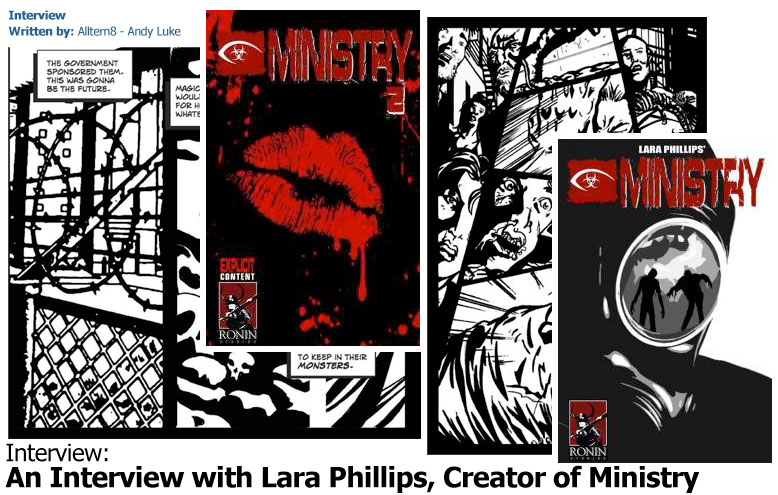
Interview with Lara Philips, Creator of Ministry

A re-blog from the archives of my regular column for Alltern8; Comicking.

lara_phillips_main1

Lara Phillips is the creator of Ronin Studios’ Ministry, a book which takes its name from the central location, a magick industrial complex and research facility of the dark arts. Set on Crowley Island, it concerns David Hanson’s survival within the facility. Having been impressed with the first issue, I sat down to have a chat with Lara about the work and became more impressed.

Alltern8: I’ve read elsewhere zombie classics and modern works such as ‘The Waking Dead’ are influences. How about those that are not so readily apparent? What other media do you feast on, horrible or helpful?

Lara Phillips: Well, I find all my influences helpful even if they give me nightmares. Stanley Kubrick’s The Shining is a classic that’s stood the test of time and of course, Clock Work Orange. Pink Floyd’s The Wall is something that influenced me in issue 2 when dealing with Hanson’s mental breakdown. But if Ministry can summed up in a few words it would be a quote from Blake’s Second Coming – “Things fall apart; the centre cannot hold; Mere anarchy is loosed upon the world.”

Alltern8: If I read right you’re based in Africa? What have been the opportunities in making comics and the response relating to The Ministry locally?

LP: South Africa is still coming into its own as far as horror’s concerned. Most of the comics here are humorous and political. Still I’ve had a great response from comic readers and have quite a strong following. I also very blessed to have my students at Style Design College as test readers. They’re always asking after my characters as if they were asking after old friends.

Alltern8: I’m looking at Page 15 of Issue 1, it’s well laid out, a marvelously brushed Renaissance engraver style beating scene. It seems you enjoyed drawing that. Do you think violence in narrative is over-employed? Surely there are many other great story devices…

LP: Hmmmm, that’s a tricky one. To be honest, I do think violence is too common in comics today. If overused, violence can definitely desensitise the reader. I’ve tried to build to the violent scenes – to use them as climatic moments rather then just titillation. Every act of violence in Ministry reveals something about the character committing it. With North, violence is just a means to an end, a form of control. With Hanson, it always intensely personal.

Alltern8: How much of The Ministry comes from reading about government figures involved in sex rings, black ops, Guantanamo Bay etc.? Where are the labs for research that make up a lot of the content of The Ministry?

LP: When I was born, Aparteid and racial segregation in South Africa was still a reality. The police were a force to be feared and the government had the power to make people vanish when they wanted. I think that has been one of my biggest influences.

The labs….hmmmm….the labs in Ministry are based on Crowley Island. Their sponsors wanted them in an isolated place in case of a occult fall out. Which of course, is exactly what happened.

Alltern8: Without naming names, I read on ‘Incoming’ you’d received some negative feedback about a rape sequence in The Ministry #3. There are some notes there about the context. Could you accurately re-present the feedback and how you feel about it?

LP: Oh, that scene….I’ve had a lot of feedback on that, locally as well. Most people thought that it was spot-on, violent without being titillating. Liam Sharp was very supportive and really gave me some comforting advice. Some critics were more upset by the nipples shown than the context. I don’t understand that – if someone’s shirtless, you’re going to see nipples. In the context of a rape, that’s NOT a turn-on for the reader and if it is, then that particular reader is a sicko. I was most concerned about the reaction of female readers but so far, a lot of women have related to the character being assaulted.

Alltern8: Talking about rape as part of a realistic horror narrative, if you’re a (spiritual) artist, seems okay to me. However, there’s no payoff, it’s a psychologically and socially fragmenting process. Without giving storytelling specifics away, how do you cope with that?

LP: Rape was one of the issues I wanted to deal with when I did Ministry. It’s more common in comics today than ever. Often once a women is raped in a comic, her life is shown as being over – she’s no use to anyone and she’ll never get over it. Bullsh*t! I wanted to show a character who is a survivor. She gets raped and still manages to overcome the trauma. In Ministry, the focus is not her rape but rather how she emerges triumphant from the trauma. I didn’t deal with this lightly – I based the scene on an experience that happened to a close friend of mine. She’s one of the strongest people I know and went on to become a black belt in kickboxing. At a later point in Ministry, I’m also going to deal with male-on-male rape. So that should stir up a hornet’s nest.

Alltern8: Talk us through the process of creating the average page of The Ministry. You’re an inking addict, but where does it start?

LP: Inking addict – that’s me. Well, I start with my rough thumb nails based on the script I’ve written. When that’s done, it’s onto neat pencils. I do my pencils in pale blue pencil so that I can ink straight over them. I really put the details in the inking. My biggest influences with shading has to be Sin City.

Alltern8: You frequently cite Lovecraft and Lynch, and the setting is named after Aleistar Crowley. Briefly say something about one aspect of your experiences with each of these three characters. Who are they and their works to you?

LP: I first discovered Lovecraft in a very dark time in my life – my mother had just died and my father was a nutcase. I loved the pessimism of his work – the concept of the cosmic abyss just beyond our sight. Many of his themes echo throughout Ministry. Lynch was discovered in a happier time – I had just met the man who would become my husband and he introduced me to Twin Peaks. The seedy underbelly of the American Dream is what I love about Lynch’s work. Twin Peaks is the kind of town I always imagine Hanson growing up in. As for Crowley, well, let’s just say I was the kind of kid who read everything and my normally conservative high school had a copy of his biography.

Alltern8: What can you tell me about Ronin Studios and the part they play in making The Ministry?

LP: Ronin has allowed me to interact with other independent comic professionals, especially Anthony Hary who has been very encouraging. My biggest professional support however would be my letterer Bernie Lee who letters Ministry from Issue 2 onwards. He’s marvelous.

Alltern8: What sort of frequency and narrative plans do you foresee for the book? Can folks buy the book in digital form, perhaps through Alltern8’s iDream facility?

LP: As Bernie and I are the entire creative team and both of us work, Ministry comes out 3 – 4 times a year. It’s available both at Indyplanet and the first issue is available through Alltern8’s (DEFUNCT) iDream facility (search ‘Lara Phillips’). As far as narrative is concerned, Ministry is filled with twists and turns. With the very gates of Hades opening, it’s going to be one hell of a joy ride.

Comicking

A re-blog from the archives of my regular column for Alltern8; Comicking.

Collected comics art, news, snippets and stories of note. The easter egg extras that don’t make it to my regular columns, but are a tasty treat nonetheless.

Stop Crime. Collect Jesus.

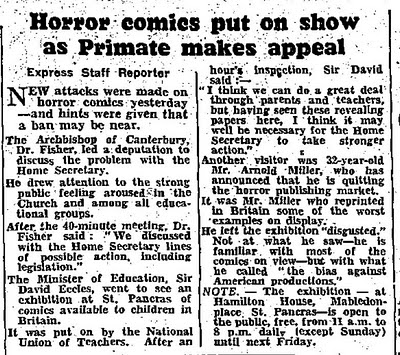
Today, Tuesday 30th at 11.00pm, BBC Radio 4 revisits Britain’s end of the 1954 McCarthy-Werthram-Horror Comics trials. “The Gorbals Vampire”  concerns invasions of schoolkid vampire hunters in a Glasgow cemetry and the consequential drive by the churches and tabloids to put horror comics publishers out of business. If you can handle abuse filtered through historical documentary, there’s a write-up and video at the BBC website (and elsewhere)

Lew Stringer put in a bit of research, and has managed to dig up some relevant newspaper archives at his blogspot.

horror comics damn church

(If you’re reading these source clippings, try replacing the words “horror comics” with “tabloid television”)

Lew also puts out a nod to Martin Barker’s “fantastic book on the UK anti-comics crusade..A Haunt of Fears”
Well said, Lew.

Three Comics Festivals In A Weekend

A lot of UK comics folk have been off over the three festivals this weekend – The Hi-Ex in Inverness, London’s UK Web and Mini Comix Thing and eh Schmurgen Con 4, which hosts it’s first awards ceremony.

So far, a few reports are in from The Thing with an illustrated piece from Aaron Foster showing off his table, substantial micro-blog and photos from Wychwolf and first-timer Freddy H with his comic strip experience.Apparently the panels were cancelled. Apparently the panels were cancelled and responses to the event were mixed – some had a great time, others got restless. Customer Tim Harries was one of the former, here’s his blog report.

Kev F Sutherland weighs in here on his Hi-Ex 2010 and Joe Gordon from Forbidden Planet on his journey there. FPI Blogger Byronv2 aka Lord Woolamaloo already has a good sized photo stream up on Flickr. Opposite, his fancy art snap of John Higgins,

And of course, customary Tweeting on SchmurgenConHiEx and The Thing.

Make Bad Comics

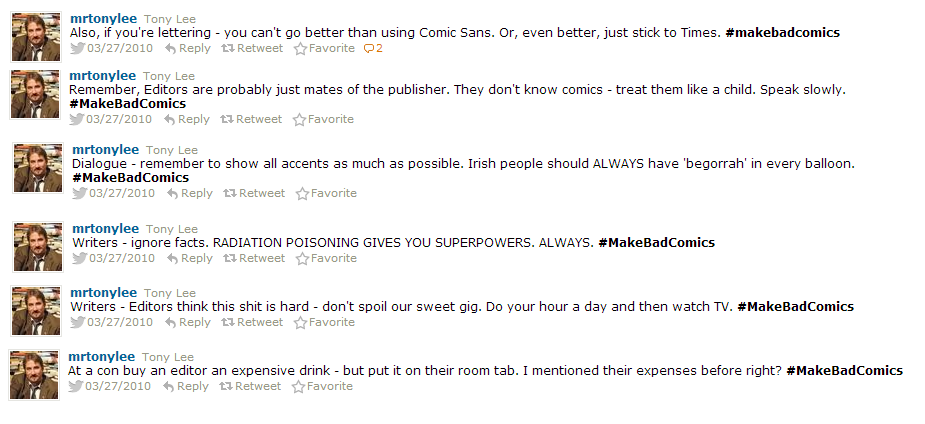
And while the rest of the UK comics scene were ‘conferencing’, sometime on Saturday night, Mr Tony Lee of the bored masses tweeted,

makebadcomics1

Followed by,

makebadcomics2

Quite soon, Paul J Holden was in on the act. Unsurprising as his Pro-Creator tweets from a few days ago had a similarly amusing style,

Pro Artist Tips: Make sure you sneak wolverine into every page – that’ll give you a good secondary income when you sell the pages…

#ArtistsTips Don’t want to draw that panel? why not photocopy an earlier panel and ENLARGE it. Almost no-one will notice.

#artiststips Marry someone rich

And so on.

I’m guessing the poor quality contents of the large selling Twilight graphic novel had something to do with the tip over point. (via Rich Jonston, one for Cerebus fans there) Or the #makeradcomics trend, not sure which came first.

With a fierce tweet-off underway, Lee and Holden must have each made around 100 tweets, with concern expressed for Holden’s health. Others got in on the act in masses on both sides of the Atlantic, creating an amusing trending topic.


deantrippe: Female superheroes should be written and drawn to appeal to 40-year-olds who think and act like 14-year-olds. #makebadcomics

Robgog: trace over photos to make people look realistic. Don’t worry that people look like their frozen in time cos it looks ‘real’ #makebadcomics

Deathnerd: Oh what the hell. The strongest protagonists are always stereotypical males. #makebadcomics

madmarvelgirl: There is no conceivable situation in which a female superhero would choose not to have her panties and/or cleavage showing. #makebadcomics

ShawnJDouglas: Yes, everyone wants a sequel to Watchmen. #makebadcomics

Richjohnston: Tell, don’t show #makebadcomics

A few serious multi-tweeters: the very funny Mike Garley, the poetical stylings of Twitsofftoya and I had a drunken go.

The people largely responsible: Tony Lee, Paul J Holden(collected on his blog)

You will want to check the variety. The hashtag is still going as I write this.

With Leonard Rifas Pt.2: Maps and Webcomics and Cyberactivism

A re-blog from the archives of my regular column for Alltern8; Comicking.

Earlier in the week I spoke with Leonard Rifas, cartoonist and publisher behind EduComics, about language, comics and Second Life. You can read that here. This time around we continue our chat about relaying messages between the virtual and the local.

Andy Luke: Given that comics is slang for ‘maps’, perhaps a narrative told using Google Maps or the like might have potential.

Leonard Rifas: I had not heard “comics” used as a slang word for “maps” before. It reminds me that I had a piece in comics format published in the Journal of Geography in 1996, in which I described a method I had worked out for drawing world maps from memory.

As for how comics might blend with maps, I keep imagining finding a program someday that would allow me to automatically translate spreadsheets, databases and other kinds of information into virtual landscapes where characters could explore and have adventures.

My doctoral dissertation, The Dataforest: Tree Forms as Information Display Graphics, was my first try at playing with the idea of using virtual environments as information landscapes. Around the time I finished that project, the field of information visualization started to really take off, but I lacked the necessary skills in computer science or statistics or even sufficient skill as an artist to get in on it. As that field develops, the technology becomes cheaper and more available and trickles down to hobbyists, so I hope to build some of the data-dreamscapes I’ve been thinking of eventually. Actually, the problem holding me back has been lack of time more than lack of tools.

I think maps and comics can fit together in many ways. I’ve incorporated maps into my educational comic book stories since I started in the 1970s.

Above: from A Method for Sketching World Maps (ERIC-locked)

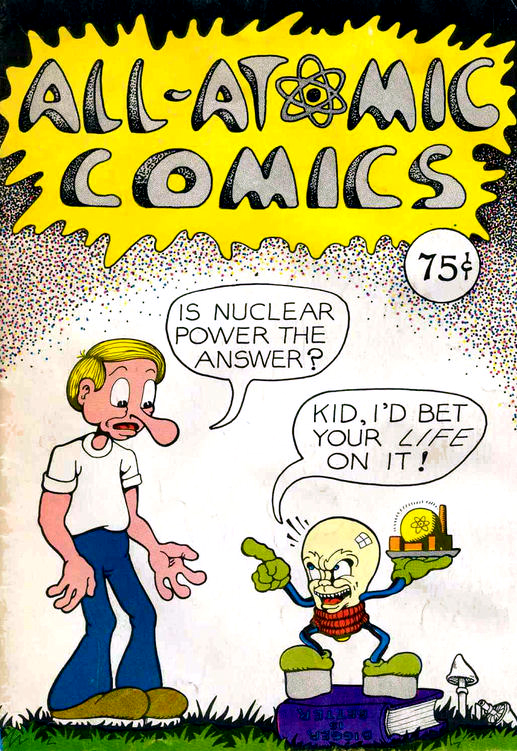
Below: All-Atomic Comics, 1976

All-Atomic_Comics_(1st_edition_front_cover)

AL: The potential of cyber-activism in the comics form: do you suppose this is something that brings new life to both?

LR: I think it can. I remember in 1985, hearing excited reports about how this rapidly approaching new information technology of the Internet would transform political organising. Now it would be hard for me to imagine living without it, and yet I feel the groups I participated in before the internet had arrived won bigger successes by going out in the streets and stopping traffic with our protests than the groups nowadays have achieved, with their daily click-here emailed petitions to our elected representatives. (I report that as my feeling. Maybe I’m looking in the wrong places for internet organising success stories. Perhaps I’m making the mistake of looking to the left for my examples rather than looking to the right.)

I take back what I said about being unable to imagine life without the internet. Last summer I took a two week vacation during which the only keyboards I touched were ATMs. It turned out not to be hard at all…. as long as I’m on vacation.

AL: One of my favourite educational activist pieces is Mills and Ezquerra’s “Third World War” which ran in the British Crisis in the nineties. Do you have any favourite edu-activist or informational comics?

LR: I’d like to read that series. In common with many other people, I think Joe Sacco has done outstanding work with informational comics, including his recent Footnotes in Gaza
I have many favourite informational and activist cartoonists. I don’t write as many reviews as I’d like to, but you can see some of my opinions in back issues of The Comics Journal.

AL: Any chance of including a brief media list of what you’re currently reading?

LR: I can’t make it brief. I usually read many books at once. Today I bought a remaindered copy of The Simpsons and Philosophy: The D’oh of Homer and read Wallace’s chapter, “A (Karl, not Groucho) Marxist in Springfield.” I also pre-ordered The Oddly Compelling Art of Denis Kitchen, which I’ve been anticipating for decades. My bathroom reading for the last several months has been Willis Barnstone’s The Restored New Testament: A New Translation with Commentary, Including the Gnostic Gospels Thomas, Mary, and Judas. I particularly appreciate how he exposes and explains the anti-Semitism in the New Testament. Mostly, though, for today’s reading I’ve been grading papers, which I enjoy.

AL: Watching and listening to?

In the background, I’m listening to Smashing Pumpkins: If All Goes Wrong. I often listen to folk music on web-radio: KBCS in nearby Bellevue, Washington and KPFA in Berkeley, California. I especially recommend Robbie Osman’s archived show “Across the Great Divide.”

Earlier today I watched Tim Burton’s Sweeney Todd: The Demon Barber of Fleet Street for the first time. I look forward to Alice in Wonderland.

AL: What are you eating at present?

LR: My wife is in Taiwan on business this week, so I had snacks instead of meals: lots of peanut butter and tomato open-faced sandwiches, (vegetarian) kim chee on tofu, “Craisins®” (dried cranberries), some handfuls of almonds and walnuts, apples, a bell pepper, Veggie Patties, some ibuprofen my doctor recommended for bursitis… basically anything handy and easy.

Comicking: March 2010

A re-blog from the archives of my regular column for Alltern8; Comicking.

Welcome to an occasional collection of comics art, news, snippets and stories of note. Once a month, I’ll bring the easter egg extras that don’t make it to my regular columns, but are a tasty treat nonetheless.
Last month, I wrote of BBC’s Eggheads’ revenge on comic’s creators, and Sean Azzopardi‘s appearances everywhere.
This time round, reviews of some comics I’ve enjoyed and themes of cinema and mental disorders. The times we’re living in…

First though, I enjoyed some great comics last night. Oliver East’s 2005 “The House of Fire To Black Hill”, a clever piece on hill walking and map musing. Richard Cowdry at Bugpowder writes East’s  “new comic is now online and free to read in your own time. It’s REALLY good.”

https://i0.wp.com/www.olivereast.com/files/gimgs/th-21_RS1cover.jpg

Believable.

Liz Greenfield’s “Stuff Sucks” also arrived in the mail. A neat little CD sized comic in a little CD sized slipcase. A bargain at only £4. Contact Liz on her website to find out if there are any left. Such pretty pictures!

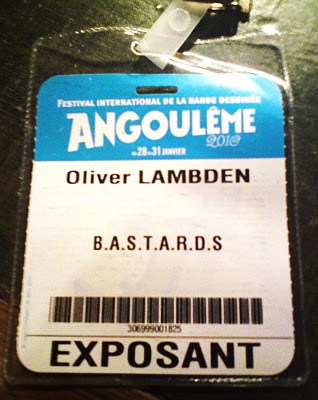
bastardstag

Oliver Lambden was at the Angouleme Festival earlier this month with other British Artists Standing Tall And Reaching Distant Shores.Amusing and insightful blog report here.

Lambden’s BLOC featured the work of an artist at an evolutionary acceleration point. This usually bodes well as is. His new project is with co-creator ofThe Rule of Death and Master of Film-like Comics Douglas Noble.

noble lambden

I prodded the lads for further details. Douglas writes, “It’s a series of theatre reviews from the 1930s. It starts on Thursday. And, right now, that’s all you need to know.” My gut feeling looking at their combined output above is that this is going to be fantastic. Keep an eye to http://thesequential.com

Every time I turn away from Livejournal I miss something great. Usually though, when I need my fix of all that is great about the webs I turn to the Internet Monkey King, Benchilada.

There you can find Ben’s F*ckbrain Comix, an account of life within his “brainmeats” including Tourettes, OCD and Bipolar Disorder. It’s probably the worst drawn comic on the web and so brilliant, I’d like to see it in print form. Ben takes amusing photos of his toys in bookstacks and manages to make eating messed up weird food look genuinely entertaining in “So You Don’t Have To“. I might have a go at that.

Particularly eye-catching recently is his brother Nathan’s Modern Family series: eleven photographed reproductions of classic paints.

Most of all, what I like about Benchilada’s livejournal is the brilliant sense of community that permeates the gaff. Never a dull moment.

Darryl Cunningham, author of Psychiatric Tales received a disheartening email this week from someone who thought he was ‘making fun’ of mental illness. Oh right, this is a news column.Darryl Cunningham has produced a colour chapter for the second volume of Psychiatric Tales. The subject matter is Electroconvulsive Therapy, and it blends years of Darryl’s experience as a psychiatric nurse with his own problems and first-hand account of someone who has actually experienced the process.

Darryl will be attending the University of London Conference on Medical Narrative in Graphic Novels, along with Paul Gravett, Brian Fies, Marc Zaffran and Philippa Parry mid-June this year.

This week I made the mad dash into relaying my experiences with epilepsy through the 24 Hour Challenge. Check out Absence, I think it’s a great piece of work.

leekennedyLee Kennedy makes marvellous strips about weight gain, couch loafing and cinema dreams which revel in pride rather than wallow. I’m sure she’s screwing with our misplaced collective guilt. Although States-born, her style tugs at something reminiscent of trad British children’s comics Beano and Dandy. Recently, she’s been happy and audible over the acquisition of a scanner, so keep an eye on Lee’s livejournal over coming months for stuff like that opposite.

And if you get through that, there’s a huge archive courtesy of the folks at Factor Fiction
Worth hurdling the livejournal blockades for.

Oh yes, and EVERYBODY is about to link to Muppet Wicker Man. Check it out, before it vanishes.

If you have an area you’d like to see covered, or a story to share, I can be emailed at drew.luke(at)gmail.com on correspondence marked ‘Comicking’. I’m also on Twitter Facebook and right here on Alltern8.com My webcomic, Don’t Get Lost, is updated Thursdays.

Comparing Manga and Britcomics festivals: social community and exhibition

A re-blog from the archives of my regular column for Alltern8; Comicking.
The opening of this post was removed by Lederkraft when they set up at the old Alltern8.com site. We hope to locate it later in the year

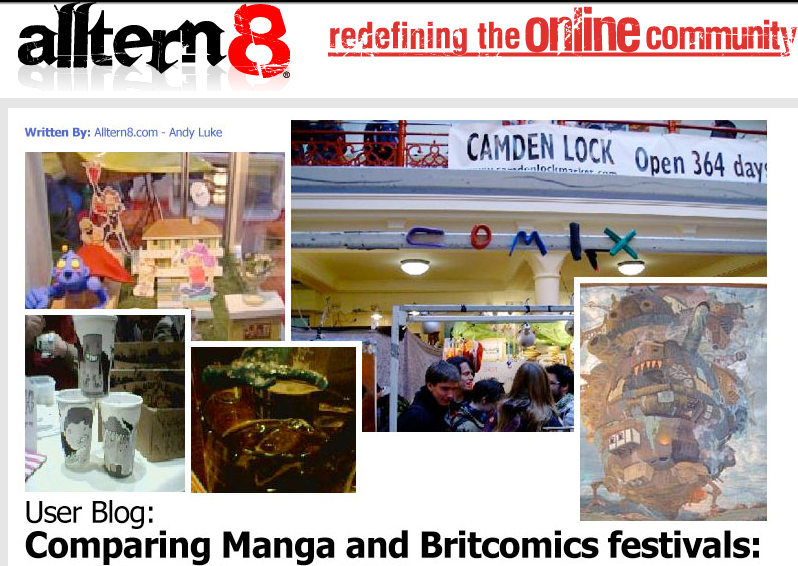
manga and brits

Comiket began running in Tokyo in 1975 with an estimated 600 visitors, assembling from non-profit dojinshi organisation. Held twice yearly, by 2002 Gravett states it amassed “35,000 exhibitors over the three days” and 500,000 attendees, its “summer 2002 exhibition catalog is almost 900 pages” according to McHarry. Indeed, its growth has become problematic and claustrophobic. In comparison, the Tokyo International Amine Fair has 130,000 visitors, and less exhibitors. This is probably due to Comiket’s figures deriving from ‘circles’, and corporate influence – the first two days of the four day festival are for press and industry professionals only.

Britain’s major comics festivals – BICS or the Birmingham International Comics Show, and the Bristol Comics Expo have a similar ‘distributors day’ before the weekend. The Expo, began in 2004, and had much in common with its predecessor United Kingdom Comic Art Convention (UKCAC) BICS began in 2006 and cartoonists and fans perform live jazz as part of an acknowledgement of the strong social tradition of these events. At both events, 3,000 – 4,000 attend. However, around ¾ of the 70+ exhibitors have traditionally been small pressers, hobbyists therefore generating much of the income needed.

BICS grew out of a dojinshi-like culture spurred on by Oxford’s long-running Caption festival. Since 1990, its opened doors to 150-200 attendees, one weekend a year. Other small press festivals of note are the slightly larger ,The UK Web and Mini Comix Thing which takes place one day a year in London and London Underground Comics, a high-profile group that occupied Camden open arts market every Saturday in 2008. In availability to consumers, the open market regularly allowed LUC to extend sales across gender and generational spectrums. Here, they come closest to achieving what manga as a culture has managed.

Allison remarks that the otaku assumes

“a social role within anime fan-dom community as opposed to engaging in isolated enjoyment of media and Japanese culture”

and states that meetings are vital parts of fan identities. Hill considers a transcultural mis-reading of the word, noting derisory connotations in Japan, and ‘badge of honour’ status overseas. This marginalisation may allow for “greater transcultural circulation of texts” and may form an identity transcending nationality. As LUC grew out of Caption heritage, Niigata arguably grew of Comiket, and both out of fan culture. First held in 1983, Niigata has 7,000-10,000 regularly in attendance and takes place twice monthly in the city.

giant sized band thing

Above: The Giant-Sized Band Thing is made up of comics creators Charlie Adlard (Drums), Paul H Birch (Bass), Liam Sharp (Vocals) and Phil Winslade (Guitar).They play Western rock/metal at the BICS festival each year and other events in between. This image is from their Facebook page.

For a sample, let’s measure three manga fairs (Tokyo International Amine Fair, Comiket and Niigata) and five British fairs (Caption, BICS, Comics Expo, The Thing and LUC) These fairs have sketching and signing, flyers, and image prints available. Only LUC does not have goodie bags, panels, workshops, movie trailers. Caption and The Comics Expo don’t have live music. I’m unable to present substantial information on Niigata though given attendance is greater than UK festivals discussed, yet with similar roots and approaches, it may be interpreted as having similar facets. Economic sponsorship differentiation would alter this.

The Tokyo Anime Fair according to Specky features hanging quilts with manga images, the sort of cross-medium work that wouldn’t be out of place at The Thing, along with cards, stickers, badges and varied dolls. Expensive promoter tools and screening of commercials are rarely found in the UK. Matt Hill  and others note the larger British and Japanese cons have common roots in SF fandom and anime:

“fandom should not be viewed as ‘isolated fan cultures but may also need to be linked to other ‘parent’ fandoms or subcutlures”

Media fluidity, Manga and anime jumping between places is quite integrated and not felt so strongly in the UK. That manga is read on commuter trains may be a truism, though it could be read as often cited to emphasise links between transportation and distribution. That Niigata is fortnightly may mean re-evaluating expectations, but these cultural factors should be kept in mind.

All feature animation reels to differentiating extent, and larger UK festivals frequently featured whole days scheduled to anime screenings. Stop motion miniatures are also common. Rarely a British comics con features a live video-game component, more likely a free CD demos is distributed. None of the Western festivals have martial arts ceremonies that Poitras remarks upon in the writing, Contemporary Anime in Japanese Pop Culture. Although tea ceremonies have cultural reflections in the strong trend of regionalised British comics pub meets.

Cosplay is a large part of life in Harajuku and Comiket is renowned for being one of the largest Cosplay events. Likely an event at every manga and anime festival, in the UK, costumed roleplayers are common sights at The Thing.

Conclusion

As I have found there is a greater cross medium fluidity and environmental input for manga festivals in Japan, readings suggest there are a number of social media trends I have not had time to look at. Differences between Manga and BritComics’ central characters make for differing relationships between reader and narrative which would make for an interesting follow-up study. Given the limitations of my ability to study the British Comiket, hosted over many weeks, a comparison of those too might be noteable.

Additional Photo Credits
Tokyo Anime Fair by Specky at Anime-Source 
Lew Stringer at his Blogspot.
Rich Bruton at Forbidden Planet

As I have the sources to hand, here’s some Further Reading

Allison, B. (Date?) Anime Fan Subculture: A Review of the Literature, Mass Communication and Society, University of Georgia. At Cornered Angel.

Craig, T.J. (2000) Japan pop!: inside the world of Japanese popular culture, M. E. Sharpe. On Google Books.

Finnegan, E. (Mar 19, 2009) Greetings from Tokyo Anime Fair, Manga Recon. PopCultureShock

Gravett, P. (2004) Manga: 60 Years of Japanese Comics, Collins

Hewitt, L. (2007) The Birmingham International Comics Show 2007, Downthetubes.net.

Kinsella, S. (October 2005) The Nationalization of Manga, Japan Society Lecture, Brunei Theatre, SOAS, London.

Liew, Z. 2 March, 2009) Monday afternoon’s Japanese Art Festival review… CobaltCafe

McHarry, M. (2001-2003?) Yaoi: Redrawing Male Love. GuideMag.

Natsume, F/ (March 2000) Japan’s Manga Culture, The Japan Foundation Newsletter, Vol. 27 No. 3/4 CorneredAngel

Patten, F. and Macek, C. (2004) Watching anime, reading manga: 25 years of essays and reviews, Stone Bridge Press, pp.13-85. GoogleBooks

Schodt, F. L. (1996) Dreamland Japan: writings on modern manga, Stone Bridge Press, ch. 7 pp.305-341. GoogleBooks

Wilson, B. Toku, M. (Date?) “Boys’ Love,” Yaoi, and Art Education: Issues of Power and Pedagogy, Visual Cultural Research in Art and Education.

Never Mind The X-Men, Its X-Mas!

A re-blog from the archives of my regular column for Alltern8; Comicking.

At this time of year, black-belts and red puffer jackets are in. However, before you congeal cotton buds for that handcrafted beard, why not consider the loving homemade gifts already for sale? Comics activists including Andrew Geczy and Matt Reynolds here at Alltern8 and others, have already compiled some lists of easy to pick up comics. The independent press offers items offers items cheaper and often so personalised that the recipient knows they’re one of a kind. And how better to have the gift delivered than right from the cartoonist’s own hand?

For the admirer of Pretty Things…

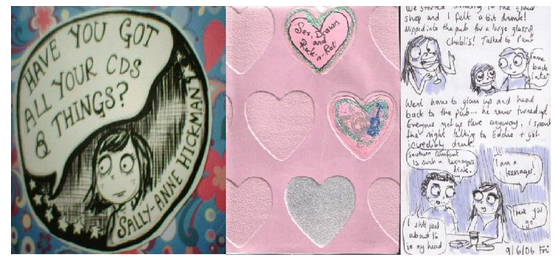
sallyannehickman 2009

Shopping at fairs, I prioritise picking up the work of Sally-Anne Hickman. Yes, always great value for money. They’re instantly recognisable, emanating sound mellow vibe covers made from wallpaper and glittery stick-ons. Lovely little things, with energetic and youthful scribblings of the author’s comic-book diary, full of character and conversation. In one of my favourites, “Have you got all your cds & things?” we get an honest, fearless and involving tale of a friendship at departure point. These are pocket-size, affordable and lovely graphic novels, all of them. You can email Sally-Anne at sallyshinystars (at)hotmail(dot)com or contact her on Facebook, a link for which can be found alongside some samples at her blog. You should be able to pick up her books for £4 or less.

druane 2010

“One Word for Everything” is a tastefully decorated collection of strips by Deirdre Ruane that should appeal to the fantasist, spiritualist and party-goer in your life, or anyone who enjoys surprises really. Deirdre describes her work better than I possibly could,

“polar bear temps. black holes in language. strange hovering artifacts. racing snails. festival dawns. selfish genes. the kitsch of the future. a caveman who dreams of aeroplanes. everyday time travel. why sex is like ice skating. why spaceships make me cry.”

Celestial festival, friendship and feel-good, melancholic and hilarious; multi-style, patterns and swirls of grace collecting strips from her fast-shifting “Wasted Epiphanies”. More details on the book at the Shop page were Deirdre will accept Paypal.  The collection costs £4.50
Other than the few sample jpegs obtained for this review, I don’t own any wares made by Richy K. Chandler. How could I recommend them for this special time of the year? Behold!

richy k chandler 2010

I have seen these up close and they’re every bit of pretty. The packaging is professionally crafted and the comics, just as much. Made of Presents! For further details and samples, check out Richy’s Myspace page. The “Cosmically Enlightened Gift Set” costs just £5 and the “Mini-Comic Box Set” is sterling value at £10, plus £2 postage and packing for each. Top tip for a tasteful gift, which is    probably too good for High Street shops everywhere.

For the Lover of Comedy….

Ralph Kidson is probably the funniest man in comics. He delivers post-modern pondering, one-dimensional veneer built to hide a variety performance showcase, bare visuals carrying superb pacing, concise character expression and obscenities, lots of obscenities. Ralph is a consummate social commentator, a snorting punk, a fantastic lover and I can count the comics of his comics I’ve been disappointed with on two fingers.

This is the perfect gift for a friend who likes edgy and relevant comedians. So why not let wish them a Sweary Christmas? *ahem*
Ralph’s tactile “Giant Clam” pocket books are a well spent £2-£3 incl. postage and packing from the Forbidden Planet shop. (123)

A few looks at quality mini-comics that won’t break the bank:

For the Artist….

Bloc by Oli Smith and Oliver Lambden

Back in June, I called Oli Smith and Oliver Lambden’s ‘Bloc’ “one of the best UK comics this year” and it still resonates. Doctor Who scribe and general independent comics revolutionary Smith says of it,

“A postmodern fairytale, BLOC is the story of a stone man washed up on the beach of a mysterious island covered in giant floating blocks…”

Indeed. In the abstract narrative within, Smith deals with themes of physics, psychics, play, philosophy and environment. Not bad for a visual instruction only script. Artist Oliver Lambden excels, whipping out strokes of Kirby, Simonson and Moebius in a work that evokes epic qualities of artistic structure. Not only do both creators significantly up their own games, but re-write comics language, stripping away its facade and celebrating it at once. The book is a tidy baige-coloured volume, classy and worked. Affordable stocking filler, definitely ideal for an artist friend. 48 pages, cost approx. £4 from Oliver Lambden.

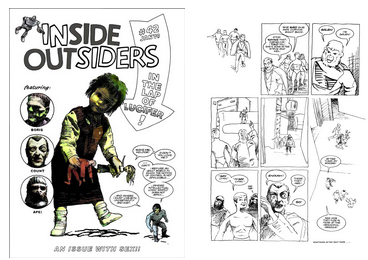
John Robbins 2009

Iconic models and their environment also feature in John Robbins ‘Inside Outsiders’, another of the finer comics I’ve read this year. Heres his ad blurb,

“Psychosexual subtext pervades this League Of Extraordinary Toy Story as action figures undertake the perilous search for a fellow room-dweller who has fled an emotionally complicated relationship with a promiscuous Bratz doll.”

Robbins’ piece is shorter and wordier than Bloc, but equally a thriller. Its written with comedic mischief, multiple definitions, paradox, and clever pace to the proceedings. Visually, its been crafted loyally with full-figure as portrait style, lacing fantasy within reality and functionality. This excellent example for good comics is a bargain at only 1.75 Euros/$2.50 US/£1.50 UK, postage included. Adults only. Available to buy at Blackshapes Shop.

The small press has also turned out a few graphic novels of note. Some of these are available in comic shops, but before that, some which aren’t.

For the Trad Comics Action Story Fan..

Winston Bulldog

The United Kingdom has had its fair share of larger-than-life comics icons: Dennis the Menace, Roy of the Rovers, Judge Dredd and Captain Winston Bulldog. Over the mid-nineties and this decade, writer Jason Cobley worked with upwards of thirty artists to deliver tales espousing the stiff-upper-lip of Blighty: eccentric, corny, brave and dashing. Alongside his action narrative, illustrators present a highly structured British metropolis, detailed with anthropomorphic and sci-fi scenes as well as stylised minimalist solid designs that are difficult to put down. Some of the strips don’t lend themselves quite so well to the reproduction, but this package is a valuable cultural historical artefact of a generation and an essential reference point in British comics. Simple action dynamics, occasional insightful humanity and some damn fine fun. With a perfect bound full colour cover the complete 208 pages can be purchased for the bargain of £7.99 here.
For the Lover of Myth and Legend….

Ness 2009

“Ness” is the opening work to Paddy Brown’s “Ulster Cycle” comic, were figures and environment gain dimension through directional pen scores and academic research shifts seamlessly into unafraid working narrative. Daughter of the king of Ulster, Ness goes on the run to track down a murderous outlaw, with a looming war between Ireland’s kingdoms for backdrop. The mythology is complimented by Paddy’s occasional lighthearted anachronisms in the script, but the meticulous adherence to source material makes this a fun educational tool as well as a great old yarn. The A5 graphic novel, collects “the full 72-page story in black and white, plus full colour cover, pronunciation guide and seven pages of notes.” and is well worth the £4.99 (incl. postage for the UK and Ireland) payable through Paypal.
Finally, two works which you should be able to pick up pretty much everywhere:

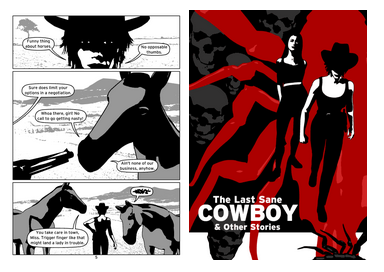
Last Sane Cowboy

Sand and skulls and the disparate wildness of literate West. Daniel Merlin Goodbrey examines contemporary anomalies through the prism of Western genre and computer-aided minimalist projection is that of a modern-day conjurer in this collection of “Tales from an Unfolded Earth”. These tales are sociology: ‘showing’ often only one or two characters, a sense of their connections with an entire society is ominous and eminent. The meta-narratives character studies’ come with personal histories, labour relations and linguistics among flowing sequences and HD coherence. Merlin Goodbrey is best known for his pioneering work on hypercomics, its to his credit that here he accomplishes providence of something with a similar highly personal feel. “The Last Sane Cowboy and Other Stories” is a cult classic and £7 or $13 well spent.  Its published by AiT/Planet Lar and you can find it on Amazon and other places.

Phonogram TSC

Phonogram has re-fuelled my interest in comics, my love towards music and is not only one of the greatest comics being made today but also the simplest.  David Kohl is a phonomancer; he uses music to make magic and because he’s a prick sometimes that goes bad. The other main character of this book is Brit-pop, a revivalist movement linked with Kohl’s essence and rewritten, along with natural reality. In writer Kieron Gillen theres all the aspects of a fantastic music journalist, teacher, poet and creative commercial visionary with tolerable arrogance, taking his cue from Moore’s definition of magic. Artist Jamie McKelvie takes his from Grant Morrisson with designer biography sigils, smart, savvy, smug and infuriating characters. Both lads are to be awarded for bringing real, relevant, clever concepts and scenarios to the audience.  Phonogram Volume 1: Rue Britannia is published by Image and you can pick the collection up for under $10.

Enough from me, Go, load up your sleigh!

23 Things About Running Comics Arts Collectives in Public Galleries

Over 2008 I wrote weekly for  ComicsVillage.com, during a very exciting time in the UK comix scene..

My columns are concerned with four aspects surrounding comics – social community, economic factors, festival and exhibition coverage and modes of distribution.

sherridancottage

Running through August I oversaw an exhibition of the works of ten cartoonists at The Oxford Jam Factory Gallery Bar and Restaurant. With little experience in arts management and administration, I just dived in there and had a go. And it worked, and it failed, and we set examples and there are lessons to be learnt.

Friendships and professionalism are ill-suited for me to expound on the lessons I’m going to impart with examples. Particularly as the experience left me with almost as much bitterness as pride and warm glow. So treat this as a checklist, and adjust in tone relating to the number of exhibitors.

Preparation

1. You should probably visit the venue a handful of times as a punter.

2. Talk to other exhibiting artists about how the gallery has treated them. Has the show been properly publicised with artists requirements met ?

3. Find out all you can about the gallery. Footfall, clientele, cost of exhibiting and how to apply. Arrange a proper professional business appointment with the gallery owner to do this, and take notes. Take lots of notes. In shorthand. Work those scribbles speeding. Keenest ear, write it all. Bring a colleague so the question-answer-dictation flow can be kept strong. How much does the venue cost and when is the money due? How much commission is to be paid per sale? When are applications due by, and what are the criteria? How tailored would the gallery be to sell mini-comics as well as originals and prints ? Do they have a web sale operation that you could tap into ? Can a full breakdown of items sold be provided so that artists individual accounting can be sorted after the group and gallery’s immmediate business has concluded ? Will the venue be used for anything else which might interfere with the space of certain artworks?

4. When you’re at the stage were it looks like a viable project, insist or demand on full documentation – a written agreement from the gallery about their responsibilites, and any compensation if they fail to deliver on their claims. Also, and this is more important, a written contract, one which details all of the fees and charges the gallery and sales there will impose upon you/your group. In addition to rent space, the big nasty VAT. My recent experiences incurred a hidden 17.5% VAT charge on sales. No laughing matter when placed atop venue space and a 30% commission. Do not rely on a gentleman’s agreement, get it in writing in advance. Also, what will the gallery impose on your selling ?

Enlisting Artists for a Group Show

With smaller venues and long-running shows its important to take into account these pointers,

5. Planning locally ? Think locally.
Local artists should always be given priority. Theyre more inclined to be able to plug in to supporting the facility’s offerings, such as on-site workshops, and ensuring the smooth running of what should never be a one-person operation (not voluntary at least) If the group is spread over areas, regionally clustered sub-groups need and should co-operate and look after one another.

6. The old adage of ‘its who you know’ comes into its fore here. Enlist your friends and those you see regularly. Go with people you can trust.

7. Inform your selection from the outset about the full details of the information you’ve gathered and what their responsibilities will be. Sharing details such as space allocated, advance planning and notification will allow the eventually assembled group plenty of parameters of movement. Construct an electronic information pack and make sure everyone understands the basic requirements of coming on board before the matter is settled.

8. Gather secondary information from your artists. Will they be available at the venue on the opening and closing days to fulfill their obligations ? Are there any holidays planned ? Other residencies or festivals or exams or work obligations theyre pinned to ? This is very important. Use your own judgement of course, but be prepared to be quite ruthless. Any problems must be dealt with as early as possible so that contigencies can be formulated. Collect phone numbers and preferred email addresses.

8andAhalf. Because I’ll be buggered if I bothered re-numbering, though this is IMportant. Again, it concerns the poobah VAT charge potential. If you have a VAT registered artist in the group, approach them about the possibility of putting the collective under their name. If they are willing to do this, they’ll be eligible for claiming all that back afterwards.

Pre-Planning

9. Even if the event is intended as a group endeavour, were weak spots appear, it assumes the form of a heirarchy. Certain individuals may be susceptible to ‘carrying the bag’ more than others. Don’t stand for it, put the foot down if needs be, and don’t stand for it.

10. Ensure that gallery fees are paid in advance, preferrably on the day of opening. Some galleries are fine being paid 14 days after the shows close. However with a group of individuals each paying a small amount, but one total bill to be met theres little room for hold ups. Its worth contacting the gallery for a bank account name, sort code and account number. In this way non-local artists can at least meet their financial obligations without having to be in the vicinity. Remember though to ensure artists confirm to you that they have made a transaction this way.

11. On workshops, tutorials, artists-in-residence. Talk to the group about these and get confirmations. Getting this set-up early will allow it to be factored into any pre-publicity and opening night announcements.

Pre-Publicity

12. One or two of the artists in the group may be called upon to create a publicity image.This should be decided upon by the group as early as possible. The finalised image should be ready to be sent to the gallery two and a half to three months in advance to allow for changes.

13. It may not be necessarry to inform the public too far in advance of the exhibit. However a week before, flyers should have been well printed and posters should be in sandwich bars. If a gallery includes promotion as part of the deal, do make sure to supplement their efforts using local blogs and events listings, as well as talking to local press contacts. In our work in this area as well as the usual comics resource sites (Bugpowder, Forbidden Planet, Downthetubes and Paul Gravett’s Events Listing), I announced it on my own blog, and on Oxford’s dreamingspires community) Deirdre Ruane prepared an official press release with contact details for community arts contacts and Oxford’s DailyInfo sites. I’d also made a listing on Eventful.com, which has an option to put it around five other events sites.

Opening Day

14. By now frames should have been acquired very cheaply at charity shops or Wilkinsons. Hold onto the little corner edges. They can be mounted onto the wall and used to hold MOO cards or other small contact cards in. Begin your art selection process well in advance, and do not, do not leave the framing until the night before. There are revisions.

15. Make sure all artists are aware of their obligations on the opening day and that all tools required (hammers, nails, spirit levels, frames) are in the vicinity.

16. Any artwork posted in should be done so with the address double-checked, sent recorded delivery. However this detached approach is not recommended as it disengages from group participation and is an unequal distribution of labour.

17. All artists should arrive on time, not two or four hours late. However if they fail to meet schedule, don’t panic! If theres a floor plan, stick with it. If not, adopt a mercenary first come, first served get on with the job mentality. Another upside of having stragglers is that not everyone is clamouring for a small supply of tools at once,

18. Ensure that all artwork is properly labelled, with pre-prepared accompanying price label to a list for its immediacy. The gallery may provide stickers, but as with publicity, don’t wait about, and take the initiative. Make sure pricing instructions are clear. If a piece is not for sale as hung, mark as such. If prints are available, likewise. Make it clear to the gallery as to whether a sold item can be picked up immediately or should be left until the end of the exhibition. Punters should be aware of this also, tell. How much are you pricing your work at? I’d suggest enough that in total it’ll cover your costs four or five times over. Jeremy Dennis suggests, “Price it as much as you’re prepared to let it go for”.

19. Get very very drunk and or enjoying yourself on opening night. Although theres correlations between violence and exuberance you may have worked hard, done a difficult job and you should treat yourself to leaving the stress in history. Besides its much more fun than masturbation and better to talk about. We also had a visitors book and a few cheapo sketch blocks for both artists and visitors to play on.

Sometime after the Morning After The Morning After

19. Workshops, tutorials and artist-in-residence sessions are great for keeping the event live. They can act as an adoptable alternative to opening night, and help to grow the contacts made then. In terms of public awareness, it helps to ensure marker points, rather than just being ‘an exhibition thats running’. Something is happening, and happenings shouldnt run out of sight. Give some serious thought to what you are doing as an artist and utilise the venue to tie into this. A work-in-progress, for example, might be drawn on site, with pages from the booklet exhibited while you go along.

20. Continue to plan in advance. Don’t let a lack of response from one or two folk fuck up everyone else’s plans of having a good time. Jettison dependency on stragglers and move forward with whatever you can.

Closing Day

21. As with before artists should be available for takedown procedure. Its unfair to ask too much of the work to be carried by a minority. Best to find out what this entails. Does spaces were arts once hung have to be pollyfilled and painted over ?  Who provides the materials and brushes?

22. Theres a likelihood that the gallery may not be able to provide a full accounting until the day after closedown. Expect this as a plausible delay in payment. Matters between gallery and exhibitors shoulld not remain unsettled longer than 14 days.

23. The best piece of advice I’ve ever been given in creating comics, the only thing you need- “Just Do It!”. Here I’d suggest ‘Just do it. Do it very carefully, professionally and in advance. Don’t do more than you need to. Comics are never a one-man show.

– Andrew Luke

Scott McCloud’s Facial Hair – Reviewing Comics

Over 2008 I wrote weekly for  ComicsVillage.com, during a very exciting time in the UK comix scene. Since then, I’ve seen new ways of approaching things, changed opinions. This is the 3rd column, about reviewing – of course, reviewing is agency, so why not become an agent instead?

My columns are concerned with four aspects surrounding comics – social community, economic factors, festival and exhibition coverage and modes of distribution.

sherridancottage

Less of a column, more of a surmountable object for reaching the top shelf this week. Facility is the engine by which uk small press comics, maybe logically, became the uk comics industry.

The fan of fanzine is not the be all: reading through my notes from a degree module which appears to focus on film critics. I come to film studies as an outsider – I go to cinemas but once or twice a year. In the last five years I’ve seen maybe fifty films. So, as an outsider coming to films (and gosh, some people don’t watch tv!), I see things…

(This may be in conflict with my experienced tutor’s stance on reviewing)

1. Verbose brow-wankers
2. Unbalanced to fiction
3. Lacking in punctuating.
4. Obligated to mention how they’re not going to give away what happens in the film.

That’s criticism for you !

I’ll not tell any of you how to review comics. I reckon most of the people reading this have read a small file binder on the matter – the fan thing just runs out of enthusiasm, doesn’t it ? If you know what makes a review difficult to read then I’d hope you wouldn’t inflict that on others.

I’m immensely proud of the 300 reviews of comics I wrote for Bugpowder-TRS2, largely over 1999-2001. I had a lot of fun experimenting with self-expression. Also thinking TOO MUCH, deliberating…I heard a story once about a well-known comics reviewer who went mad through the action, and went to live in a remote hilly region and never again touched the area of comics. However, I prefer the story about Ralph Kidson creating a comic book on a door or doors – sad to hear about the successful buyer trying to get it onto the bus, even with the sub-thought of it being bound together with hinges.

If you want a starter for reviewing I’d suggest looking to Pete Ashton’s original TRS reviews. A practical fifty words which touched upon key features such as genre classifying,  background info, advertising, abbreviated arguments and evaluation, social and redemptive values, motivational theory. Condensed synopsis sometimes got a look in. Pete’s reviews, in retrospect, read as if he has ascribed one or two words to each of these aspects amd joined them all together. I remember reading these at the time and them coming across simple and practical.

Reviewing small press comics in the olden days happened in small press comics. A few lines to cheer for comix that caused enjoyment rescued this medium from isolation and devoted readers to new and surprising joy.

You have to decide for yourself nowadays on whether to include the purchase details of the comics, and take advice from the author on including contact details. With the small press scene being fed into progressive places of business, its not quite as simple for a commentator to include a single address. I’m not buying comics through the post as I used to, and I suspect web-people are letting that happen less and less.

Shorter column today, rather than none at all. The Camden Lock fire yesterday has us all emotionally upset. It was a terrible fuckedly inconsistent end to a day.

So anyway,

Tofu + Cats / A Dinosaur Tale by Lizz Lunney : It’s in the title, and better for a chant.

Jason Elvis – Sex Change Diaries of a Pear Shaped Boy. Rich honest human quality with a trad zine feel. Great grasps !  & speculation, commentary – Very naughty and very very funny

Club Mephistopheles by Grave Graham – 3-D comics that hit the nose, where definition is told to relax by stream-of-conscious improv and energy.

The Wrong Girl – A welcome return to friendly minutiae of social relationships stories by a master translator, Tony McGee.

Monkeys Might Puke by Dan Lester – embarassingly funny, shallow, comedy gold, miss or hit, enthusiasm, ambition, passion and devotion.

Rocket by Bridgeen Gillespie – Works on so many levels, and it’s quite worth the shiny heavier stock paper it’s been so well printed on. Black, white and greyscale merit !

Predator Vs Columbo – Not sure this is an ‘instant classic’ as Johnston states on his website, it is very good and delivers the smiles from memory. The website is http://www.virginiagallery.co.uk and you can read the piece up there.

Inner City Pagan by Lee Kennedy caused a bunch of teenage students to stare at me with envy.

Karrie Fransman’s ‘Abigail Tells All’ is a work of great merit, long resonance and deserves to be on the agenda of more readers.

Sheridan Cottage will continue building on the fortnight, at this very website. I’ll be popping around the comments section, though now I’m going to hear if I could learn a few tricks from Mark Kermode’s podcast. 

Pete’s reviews http://bugpowder.com/trs2/oldtrs2.html
Also recommend do I, http://thetenwordreview.com/ 

(I’ve read Comics Village are also keen for reviewers !)

Donate to Andrew Luke’s personal grooming fund

Andrew Luke